
How Long Do Hemorrhoids Last? Timeline by Type & Treatment (2026)
If you are wondering "how long does a hemorrhoid last," the answer depends heavily on the type of hemorrhoid, its severity, and how you treat it. A study in *Diseases of the Colon & Rectum* found that untreated hemorrhoids have a recurrence rate of approximately 10-50% depending on grade and patient
How long do hemorrhoids last? Mild external hemorrhoids typically resolve within 2-7 days with proper home care, while thrombosed hemorrhoids take 2-3 weeks to heal. Internal hemorrhoids may persist for weeks or months without treatment, and chronic hemorrhoids can recur for years if underlying causes are not addressed.
If you are wondering "how long does a hemorrhoid last," the answer depends heavily on the type of hemorrhoid, its severity, and how you treat it. A study in Diseases of the Colon & Rectum found that untreated hemorrhoids have a recurrence rate of approximately 10-50% depending on grade and patient factors (Davis et al., 2018). Understanding realistic timelines helps you set proper expectations and know when to seek professional help.
See a doctor if symptoms last more than a week or two, keep returning, or come with heavy bleeding, severe pain, or a hard painful lump. Mayo Clinic advises seeing a doctor if hemorrhoid symptoms do not improve after about a week of home care, and treating rectal bleeding as something to evaluate rather than assume.
How Long Do Mild External Hemorrhoids Last?
Mild external hemorrhoids, the small, soft bumps around the anus that cause itching, discomfort, or minor pain, are the most common type and fortunately the quickest to resolve.
Expected timeline:
| Stage | Timeframe | What to Expect |
|---|---|---|
| Onset | Day 1-2 | Swelling, itching, mild pain |
| Peak symptoms | Day 2-4 | Maximum discomfort and swelling |
| Improvement | Day 4-5 | Swelling begins to decrease |
| Resolution | Day 5-7 | Symptoms mostly or fully resolved |
According to clinical data published in the American Journal of Gastroenterology, approximately 87% of mild hemorrhoid episodes resolve within one week with conservative home treatment including sitz baths, fiber supplementation, and topical treatments (Jacobs, 2014).
What speeds up recovery:
- Warm sitz baths 2-3 times daily
- Increased water intake (8+ glasses per day)
- Fiber supplementation to soften stools
- Avoiding straining during bowel movements
- Topical treatments like Lidocaine Cream for pain management
How Long Does a Thrombosed Hemorrhoid Last?
Thrombosed hemorrhoids, those firm, blue-purple lumps caused by a blood clot, follow a longer and more painful timeline than regular hemorrhoids.
Expected timeline:
| Stage | Timeframe | What to Expect |
|---|---|---|
| Acute pain phase | Day 1-3 | Severe, constant pain; peak swelling |
| Pain plateau | Day 3-5 | Pain begins to stabilize |
| Gradual improvement | Day 5-14 | Clot slowly dissolves; pain decreases |
| Near resolution | Week 2-3 | Swelling mostly resolved; mild discomfort may linger |
| Complete healing | Week 3-4 | Fully healed, possible residual skin tag |
Research in Techniques in Coloproctology shows that thrombosed hemorrhoids treated conservatively resolve within an average of 2-3 weeks, with pain peaking in the first 48-72 hours (Greenspon et al., 2004). Excision within the first 72 hours can provide faster pain relief, with studies showing a mean resolution time of 3.9 days after surgical excision compared to 24 days with conservative management.
Important note: If a thrombosed hemorrhoid is causing severe pain and you are within the first 72-hour window, consult a doctor about in-office excision. After 72 hours, the clot is already beginning to dissolve and conservative treatment is generally preferred.
How Long Do Internal Hemorrhoids Last?
Internal hemorrhoids follow a different pattern because they develop inside the rectum. Duration depends heavily on the grade of the hemorrhoid.
Timeline by grade:
Grade I Internal Hemorrhoids (Bleeding Only)
- Duration: Often resolve within 1-2 weeks with dietary changes and supplements
- Recurrence: Common without ongoing prevention measures
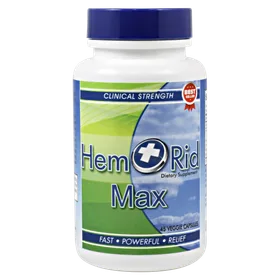
- Treatment approach: Fiber supplementation, increased hydration, oral supplements like HemRid Max
Grade II Internal Hemorrhoids (Prolapse with Spontaneous Reduction)
- Duration: May take 2-4 weeks to fully resolve
- Recurrence: Moderate risk; approximately 30% recurrence within 3 years
- Treatment approach: Conservative treatment; rubber band ligation if persistent
Grade III Internal Hemorrhoids (Require Manual Reduction)
- Duration: Rarely resolve completely on their own; weeks to months
- Recurrence: High without procedural intervention
- Treatment approach: Often requires rubber band ligation or other office procedures
Grade IV Internal Hemorrhoids (Cannot Be Reduced)
- Duration: Do not resolve without medical intervention
- Recurrence: Dependent on treatment method
- Treatment approach: Surgical hemorrhoidectomy typically required
A meta-analysis in the British Journal of Surgery found that rubber band ligation for Grade II-III hemorrhoids has a success rate of approximately 80% with a median healing time of 2-4 weeks post-procedure (Simillis et al., 2015).
These statements have not been evaluated by the Food and Drug Administration. This product is not intended to diagnose, treat, cure, or prevent any disease.
How Long Do Hemorrhoids Last with Treatment?
The type of treatment you choose significantly impacts how quickly hemorrhoids resolve. Here is a comparison of common treatment approaches and their expected timelines.
Treatment Timeline: Topical Creams and Ointments
- Time to symptom relief: 1-3 days for itching and pain reduction
- Time to full resolution: 5-10 days for mild hemorrhoids
- Best for: External hemorrhoids with itching, burning, or mild pain
- Limitation: Does not treat internal hemorrhoids; symptom relief only
Lidocaine Cream provides numbing relief that starts working within minutes, making daily activities more comfortable while the hemorrhoid heals.
Treatment Timeline: Oral Supplements
- Time to symptom relief: 1-3 days for many users
- Time to full resolution: 7-14 days when combined with lifestyle changes
- Best for: Internal and external hemorrhoids; comprehensive approach
- Advantage: Works from the inside to support vein health
HemRid Max contains clinically studied ingredients like diosmin, hesperidin, and witch hazel extract that support healthy blood vessels and normal inflammatory response. Many users report noticeable improvement within the first few days of use.
These statements have not been evaluated by the Food and Drug Administration. This product is not intended to diagnose, treat, cure, or prevent any disease.
Treatment Timeline: Sitz Baths
- Time to symptom relief: Immediate temporary comfort during bath
- Time to full resolution: Supports healing over 5-10 days when used 2-3 times daily
- Best for: All hemorrhoid types; excellent complementary treatment
Treatment Timeline: Medical Procedures
- Rubber band ligation: 1-2 weeks to full healing; 80% long-term success rate
- Sclerotherapy: 1-2 weeks to see results; may require multiple sessions
- Infrared coagulation: 1-2 weeks healing; best for small, bleeding internal hemorrhoids
- Surgical hemorrhoidectomy: 2-4 weeks recovery; 95% long-term success rate but most painful recovery
How Long Do Chronic Hemorrhoids Last?
Some people deal with hemorrhoids that seem to never fully go away or that keep coming back. Chronic hemorrhoids are defined as hemorrhoidal symptoms lasting longer than 4 weeks or recurring 3 or more times per year.
Factors that contribute to chronic hemorrhoids:
- Chronic constipation or diarrhea
- Low-fiber diet (less than 25g per day)
- Sedentary lifestyle or prolonged sitting
- Obesity (BMI over 30)
- Pregnancy and postpartum period
- Genetic predisposition to weak venous walls
- Heavy lifting without proper breathing technique
A longitudinal study published in Colorectal Disease found that patients with untreated chronic hemorrhoids had a 50% recurrence rate within 5 years, while those who combined lifestyle modifications with appropriate treatment reduced recurrence to approximately 15% (Alonso-Coello et al., 2006).
Breaking the cycle of chronic hemorrhoids requires:
- Daily fiber intake of 25-35 grams, Fiber Gummies make it easy to supplement your daily intake
- Adequate hydration, at least 8 glasses of water per day
- Regular physical activity, 30 minutes most days
- Proper toilet habits, no straining, no sitting longer than 5 minutes
- Ongoing vein support, HemRid Max provides daily ingredients that support vascular health
These statements have not been evaluated by the Food and Drug Administration. This product is not intended to diagnose, treat, cure, or prevent any disease.
When Hemorrhoids Last Too Long: Warning Signs
While most hemorrhoids resolve with home treatment, certain situations call for professional medical evaluation:
- Hemorrhoid symptoms lasting longer than 2 weeks without improvement despite home treatment
- Rectal bleeding that is dark red or black rather than bright red
- Bleeding that does not stop or is heavy in volume
- Severe pain that prevents normal activities or sleep
- Signs of infection including fever, increasing redness, warmth, or discharge
- Hemorrhoid symptoms in someone over 45 who has not had a recent colonoscopy
The American College of Gastroenterology recommends that persistent hemorrhoidal bleeding in patients over 40 should prompt endoscopic evaluation to exclude malignancy (Wald et al., 2014).
How to Make Hemorrhoids Go Away Faster
Based on clinical evidence, the fastest way to resolve hemorrhoids combines multiple approaches:
Day 1-2: Begin sitz baths (15-20 minutes, 2-3 times daily), start HemRid Max, increase water intake, apply Lidocaine Cream for external pain relief.
Day 2-5: Continue all treatments. Begin Fiber Gummies or other fiber supplementation. Avoid prolonged sitting. Use a step stool to elevate knees during bowel movements.
Day 5-7: Most mild hemorrhoids will show significant improvement. Continue fiber and hydration. Reduce sitz bath frequency to once daily.
Day 7-14: Mild hemorrhoids should be resolved. If significant symptoms persist, consult a healthcare provider for evaluation.
A clinical trial published in the British Journal of Surgery demonstrated that patients using a combination of oral flavonoid supplements plus conservative measures had a 34% faster symptom resolution compared to conservative measures alone (Perera et al., 2012).
Frequently Asked Questions About Hemorrhoid Duration
Can hemorrhoids last for months?
Yes. Grade III-IV internal hemorrhoids and untreated chronic hemorrhoids can persist for months. If your hemorrhoids have lasted longer than 4 weeks, consult a healthcare provider for evaluation and treatment options.
Do hemorrhoids go away on their own?
Mild hemorrhoids (Grade I-II) often resolve on their own within 1-2 weeks. However, treatment significantly speeds recovery and reduces recurrence risk. More severe hemorrhoids typically require intervention.
Why do my hemorrhoids keep coming back?
Recurring hemorrhoids are usually caused by unaddressed root factors: low fiber diet, chronic constipation, prolonged sitting, or inadequate hydration. Addressing these underlying causes is essential for long-term relief.
How long do postpartum hemorrhoids last?
Hemorrhoids developed during pregnancy or delivery typically improve within 2-4 weeks after birth as hormonal changes normalize and pelvic pressure decreases. Some may persist for 6-8 weeks. Consult your OB-GYN if they have not improved by your postpartum checkup.
Speed Up Your Recovery with the Right Treatment Plan
How long hemorrhoids last depends on their type, severity, and your treatment approach. Mild external hemorrhoids resolve fastest at 5-7 days, while thrombosed and higher-grade internal hemorrhoids require more time and potentially medical intervention.
For the fastest relief at home, combine HemRid Max for internal vein support, Lidocaine Cream for external comfort, and Fiber Gummies for long-term prevention. This inside-and-outside approach addresses hemorrhoids from every angle and helps prevent recurrence.
These statements have not been evaluated by the Food and Drug Administration. This product is not intended to diagnose, treat, cure, or prevent any disease.
---
References:
- Davis, B. R., et al. (2018). The American Society of Colon and Rectal Surgeons clinical practice guidelines for the management of hemorrhoids. Diseases of the Colon & Rectum, 61(3), 284-292.
- Jacobs, D. (2014). Clinical practice: Hemorrhoids. New England Journal of Medicine, 371(10), 944-951.
- Greenspon, J., et al. (2004). Thrombosed external hemorrhoids: Outcome after conservative or surgical management. Techniques in Coloproctology, 8(2), 108-111.
- Simillis, C., et al. (2015). Systematic review and network meta-analysis comparing clinical outcomes of surgical treatments for hemorrhoids. British Journal of Surgery, 102(13), 1603-1618.
- Alonso-Coello, P., et al. (2006). Fiber for the treatment of hemorrhoids complications. Cochrane Database of Systematic Reviews, (4), CD006304.
- Perera, N., et al. (2012). Phlebotonics for hemorrhoids. Cochrane Database of Systematic Reviews, (8), CD004322.
- Wald, A., et al. (2014). ACG clinical guideline: Management of benign anorectal disorders. American Journal of Gastroenterology, 109(8), 1141-1157.
What actually works for hemorrhoids
If you're dealing with pain right now, a topical cream is a great first step — it numbs the area for fast relief. To actually get rid of the problem, HemRid Max works from the inside out to strengthen vein walls and reduce swelling. The best results come from doing both.